Posted December 26, 2025 in Dermatology, osteoma forehead
Ashburn, VA | Mountcastle Plastic Surgery & Vein Institute

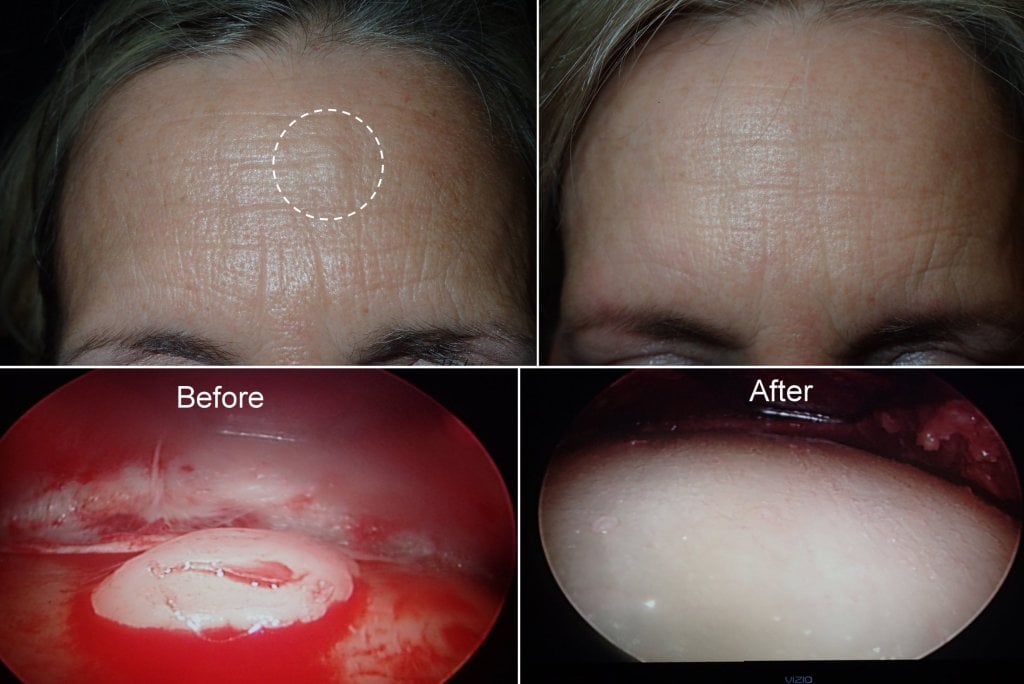
A firm, slowly growing bump on the forehead can be frustrating and concerning, especially when it becomes more noticeable over time. For many patients, that bump turns out to be a forehead osteoma—a benign bony growth arising from the skull. While osteomas are not dangerous, they often become a cosmetic concern, particularly when located in the central forehead or near the hairline.
At Mountcastle Plastic Surgery & Vein Institute, forehead osteoma removal is performed with a focus on both complete removal and an excellent cosmetic outcome. Patients frequently ask what their before-and-after results will look like, how long healing takes, and when they can expect the final result. Understanding the healing timeline is key to setting realistic expectations.
What Is a Forehead Osteoma?
A forehead osteoma is a benign, slow-growing bone tumor that typically develops from the outer table of the skull. These growths are non-cancerous and often discovered incidentally or after patients notice a hard, immobile lump that does not change with facial expression.
Osteomas can vary in size and shape. Some are small and subtle, while others can become prominent enough to distort the natural contour of the forehead. Although they rarely cause pain, many patients seek removal because the bump becomes more visible in photos, makeup no longer sits smoothly, or hairstyles are chosen specifically to hide it.
For a general medical overview of osteomas, you can visit this external resource:
External link: https://my.clevelandclinic.org/health/diseases/22510-osteoma
Forehead Osteoma Removal: Surgical Approach
The goal of forehead osteoma surgery is to remove the bony growth while preserving a smooth, natural forehead contour. Surgical planning depends on the size and location of the osteoma, as well as the patient’s hairline and skin characteristics.
In many cases, the incision is carefully placed within the hairline or a natural crease to minimize visible scarring. Specialized instruments are used to contour the bone precisely after removal, ensuring that the surrounding forehead surface remains smooth.
You can learn more about facial and reconstructive procedures offered at our practice here:
Internal link: Facial Surgery Procedures at Mountcastle Plastic Surgery
Before and After: Understanding the Healing Timeline
One of the most important things patients need to understand is that before-and-after results evolve over time. Forehead osteoma removal is not an overnight transformation, even though the osteoma itself is removed during surgery.
Early Healing (First 1–3 Weeks)
At around three weeks post-op, patients are still very much in the healing phase. Mild swelling, firmness, redness, or slight contour irregularities can be present. The incision may still look pink or raised, and the forehead can feel tight or numb. This is normal and expected.
At this stage, patients sometimes worry that the area does not look “perfect yet,” but it is far too early to judge final results.
Intermediate Healing (1–3 Months)
Between one and three months after surgery, swelling continues to resolve and the forehead contour becomes smoother. The incision begins to fade, and the skin gradually softens. Any residual firmness usually improves as deeper tissues continue to heal.
This is when most patients start to feel confident going without makeup or hairstyle camouflage.
Final Results (3–6 Months)
By three months, most patients see a dramatic improvement in both contour and scar appearance. The incision typically fades significantly, and the forehead looks natural and balanced. Final scar maturation can continue for up to a year, but the majority of visible healing occurs in the first few months.
What Forehead Osteoma “Before and After” Really Means
When reviewing before-and-after photos, it’s important to remember that images taken at three weeks post-op do not represent the final result. Early photos may still show swelling or redness, while later images demonstrate how refined and natural the outcome becomes.
A successful forehead osteoma removal should leave the forehead looking smooth, symmetric, and free of the hard bony prominence that once drew attention.
For patients interested in learning about scar care and optimization, the American Society of Plastic Surgeons offers helpful guidance:
External link: https://www.plasticsurgery.org/reconstructive-procedures/scar-revision
Recovery Tips for Best Results
Following post-operative instructions plays a major role in achieving an excellent outcome. Patients are typically advised to avoid strenuous activity early on, protect the incision from sun exposure, and follow scar-care recommendations as directed.
Sun protection is particularly important for forehead incisions, as UV exposure can darken scars during the healing phase. Wearing hats and using physician-recommended sunscreen once cleared can significantly improve long-term scar appearance.
You can also review our post-operative care resources here:
Internal link: Post-Operative Instructions and Recovery Guide
Why Patients in Ashburn Choose Mountcastle Plastic Surgery
Patients from Ashburn, Leesburg, Loudoun County, and the surrounding Northern Virginia area often seek a surgeon who understands both the functional and cosmetic aspects of forehead osteoma removal. The goal is not simply to remove the bone, but to restore a natural forehead contour with minimal evidence of surgery.
Careful incision placement, meticulous technique, and realistic preoperative counseling are essential to achieving results patients feel confident about.
Final Thoughts
Forehead osteoma removal offers a highly effective solution for patients bothered by a visible bony forehead bump. While early healing photos may still show swelling at three weeks, patience is key. By three months, most patients see a smooth contour and a significantly faded incision, with continued improvement over time.
If you are considering forehead osteoma removal and want to understand what your before-and-after results may look like, a personalized consultation is the best place to start.
To schedule a consultation or learn more, visit:
Internal link: Schedule a Consultation at Mountcastle Plastic Surgery
This procedure is as much about thoughtful planning and healing as it is about the surgery itself, and with the right approach, the final result can look natural, balanced, and long-lasting.
